Writings on an Ethical Life by Peter Singer
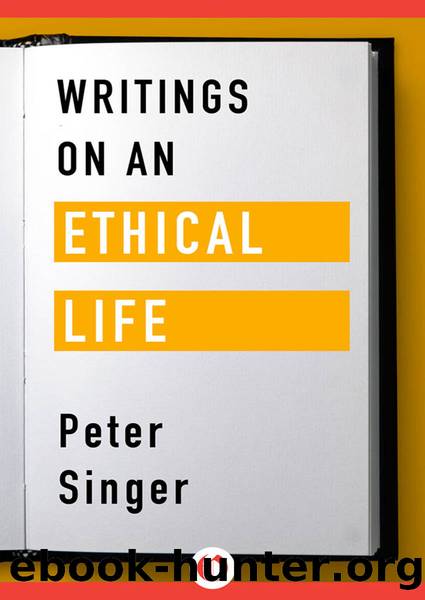
Author:Peter Singer [Singer, Peter]
Language: eng
Format: epub
ISBN: 9781497645585
Published: 0101-01-01T00:00:00+00:00
Justifying Infanticide
FROM Practical Ethics
If we were to approach the issue of life or death for a seriously disabled human infant without any prior discussion of the ethics of killing in general, we might be unable to resolve the conflict between the widely accepted obligation to protect the sanctity of human life and the goal of reducing suffering. Some say that such decisions are âsubjective,â or that life-and-death questions must be left to God and nature. Our previous discussions have, however, prepared the ground, and the principles established and applied in the preceding pages make the issue much less baffling than most take it to be.
The fact that a being is a human being, in the sense of a member of the species Homo sapiens, is not relevant to the wrongness of killing it; it is, rather, characteristics like rationality, autonomy, and self-consciousness that make a difference. Infants lack these characteristics. Killing them, therefore, cannot be equated with killing normal human beings, or any other self-conscious beings. This conclusion is not limited to infants who, because of irreversible intellectual disabilities, will never be rational, self-conscious beings. We saw in our discussion of abortion that the potential of a fetus to become a rational, self-conscious being cannot count against killing it at a stage when it lacks these characteristicsânot, that is, unless we are also prepared to count the value of rational self-conscious life as a reason against contraception and celibacy. No infantâdisabled or notâhas as strong a claim to life as beings capable of seeing themselves as distinct entities, existing over time.
The difference between killing disabled and normal infants lies not in any supposed right to life that the latter has and the former lacks, but in other considerations about killing. Most obviously there is the difference that often exists in the attitudes of the parents. The birth of a child is usually a happy event for the parents. They have, nowadays, often planned for the child. The mother has carried it for nine months. From birth, a natural affection begins to bind the parents to it. So one important reason why it is normally a terrible thing to kill an infant is the effect the killing will have on its parents.
It is different when the infant is born with a serious disability. Birth abnormalities vary, of course. Some are trivial and have little effect on the child or its parents, but others turn the normally joyful event of birth into a threat to the happiness of the parents and any other children they may have.
Parents may, with good reason, regret that a disabled child was ever born. In that event the effect that the death of the child will have on its parents can be a reason for, rather than against killing it. Some parents want even the most gravely disabled infant to live as long as possible, and this desire would then be a reason against killing the infant. But what if this is not the case? In the discussion that follows I shall assume that the parents do not want the disabled child to live.
Download
This site does not store any files on its server. We only index and link to content provided by other sites. Please contact the content providers to delete copyright contents if any and email us, we'll remove relevant links or contents immediately.
| Anthropology | Archaeology |
| Philosophy | Politics & Government |
| Social Sciences | Sociology |
| Women's Studies |
The remains of the day by Kazuo Ishiguro(9081)
Tools of Titans by Timothy Ferriss(8490)
Giovanni's Room by James Baldwin(7432)
The Black Swan by Nassim Nicholas Taleb(7193)
Inner Engineering: A Yogi's Guide to Joy by Sadhguru(6835)
The Way of Zen by Alan W. Watts(6669)
The Power of Now: A Guide to Spiritual Enlightenment by Eckhart Tolle(5854)
Asking the Right Questions: A Guide to Critical Thinking by M. Neil Browne & Stuart M. Keeley(5831)
The Six Wives Of Henry VIII (WOMEN IN HISTORY) by Fraser Antonia(5557)
Astrophysics for People in a Hurry by Neil DeGrasse Tyson(5224)
Housekeeping by Marilynne Robinson(4502)
Double Down (Diary of a Wimpy Kid Book 11) by Jeff Kinney(4332)
12 Rules for Life by Jordan B. Peterson(4331)
Ikigai by Héctor García & Francesc Miralles(4310)
The Ethical Slut by Janet W. Hardy(4307)
Skin in the Game by Nassim Nicholas Taleb(4305)
The Art of Happiness by The Dalai Lama(4167)
Skin in the Game: Hidden Asymmetries in Daily Life by Nassim Nicholas Taleb(4050)
Walking by Henry David Thoreau(3998)
